April 13, 2026 • Marlowe Finch • 10 min reading time • Specs verified June 4, 2026
Ultra Short Throw Laser TVs: The Epson LS800 vs. AWOL vs. Hisense PL2 Decision Guide
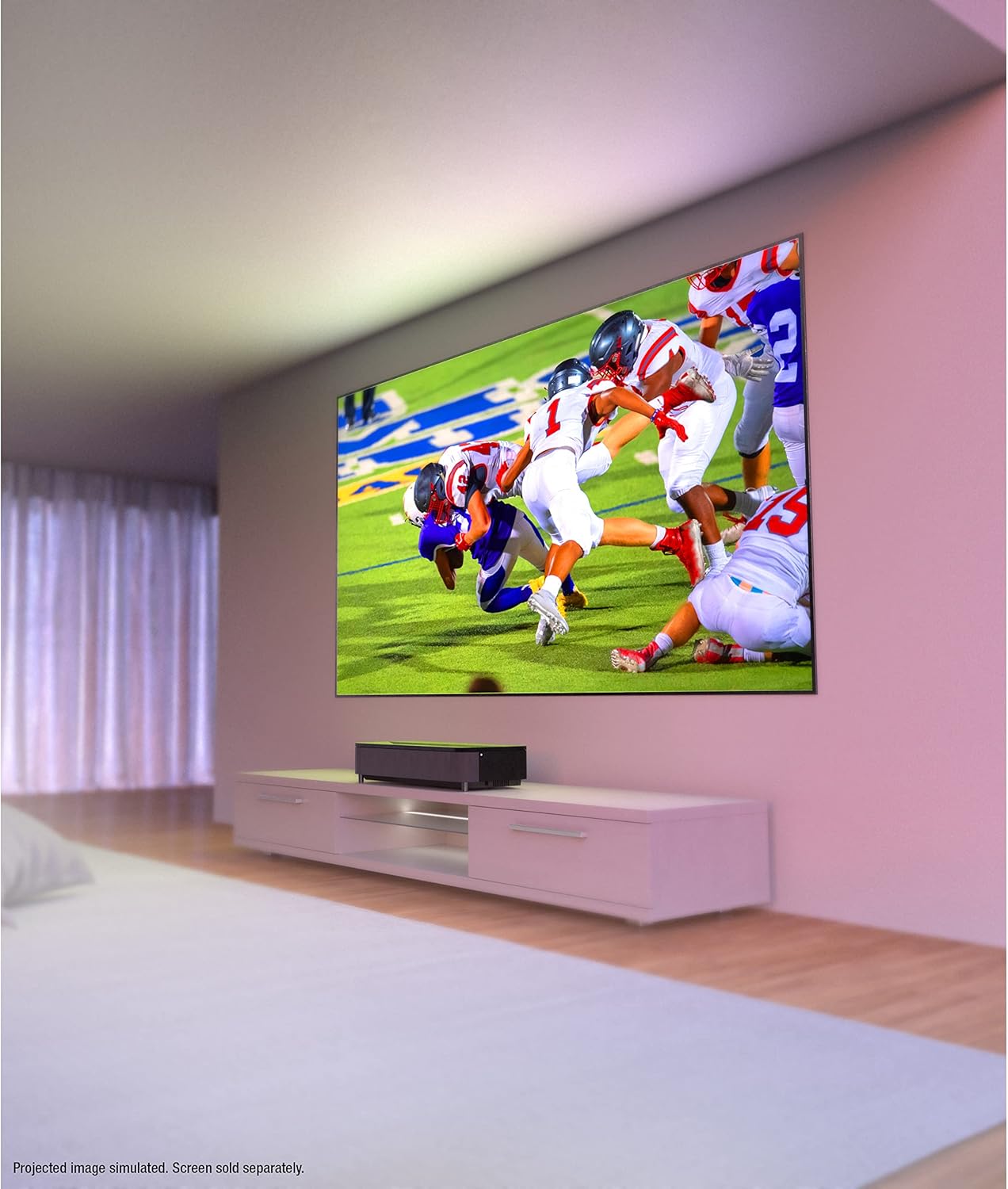
Imagine a projector that sits just a few inches in front of your wall — no ceiling mount, no dedicated dark room required — and throws a 100-inch picture from a box you could rest a bowl of chips on. That’s what ultra short throw (UST) laser projectors do. Unlike a traditional projector that needs ten or twelve feet of throw distance to fill a large screen, a UST unit is designed to sit on a credenza or the floor directly below the screen and project upward and outward at a steep angle. Add a laser light source — brighter, longer-lived, and more color-accurate than a lamp — and you get a category often marketed as a “Laser TV”: a genuine big-screen alternative to a large flat-panel television, capable of 100–150 inches of image from a standard living room.
If you’re already past the “what is this thing” stage and are circling a buy decision among the Epson LS800, the AWOL Vision LTV series, and the Hisense PL2 (also branded as the TriChroma Laser TV in some markets), this guide is for you. All three sit in the $2,300–$3,500 street-price range as of mid-2026. All three are genuinely capable. The differences between them are real but subtle enough that a meaningful number of buyers end up with the wrong unit for their specific room conditions and priorities. We’ll show you the tradeoffs explicitly and close with a clean decision rule.
What You’re Actually Comparing: The Three Variables That Matter
Before going model by model, it’s worth naming the three axes that separate these projectors in day-to-day use.
Brightness (measured in ANSI lumens) determines how well the image holds up when ambient light is present — afternoon light through blinds, a lamp in the corner, a television-lit family room. UST projectors aimed at living room use have to fight harder against ambient light than a dedicated home theater projector does, because they live in rooms that aren’t controlled dark environments. RTINGS.com’s UST projector and laser TV buying guide places brightness near the top of its evaluation criteria specifically for this reason.
Color system — three-laser versus single blue laser plus phosphor — A true triple-laser (RGB) design uses separate red, green, and blue laser diodes to produce color, which typically widens the color gamut and improves color accuracy at peak brightness. A blue-laser-plus-phosphor system is more common at lower price points and remains excellent, but reviewers at Sound & Vision and Home Theater HiFi consistently note a measurable advantage in color volume for full RGB designs under controlled testing conditions, as documented in the Sound & Vision review of the AWOL Vision LTV-3500 Pro and the Home Theater HiFi ultra short throw projector comparison, 2025 edition.
Included screen versus projector-only pricing — Some units ship bundled with a purpose-built ALR (Ambient Light Rejecting) screen — a screen material engineered to reflect light coming from below (the projector) while absorbing overhead ambient light from ceiling fixtures and windows. ALR is not optional in a real living room UST setup. If the screen isn’t included, budget $800–$1,500 to add one separately from brands such as Elite Screens or Silver Ticket.
With that framing in place, here is where each model lands.
Model-by-Model Breakdown
Epson LS800 — The Balanced Workhorse
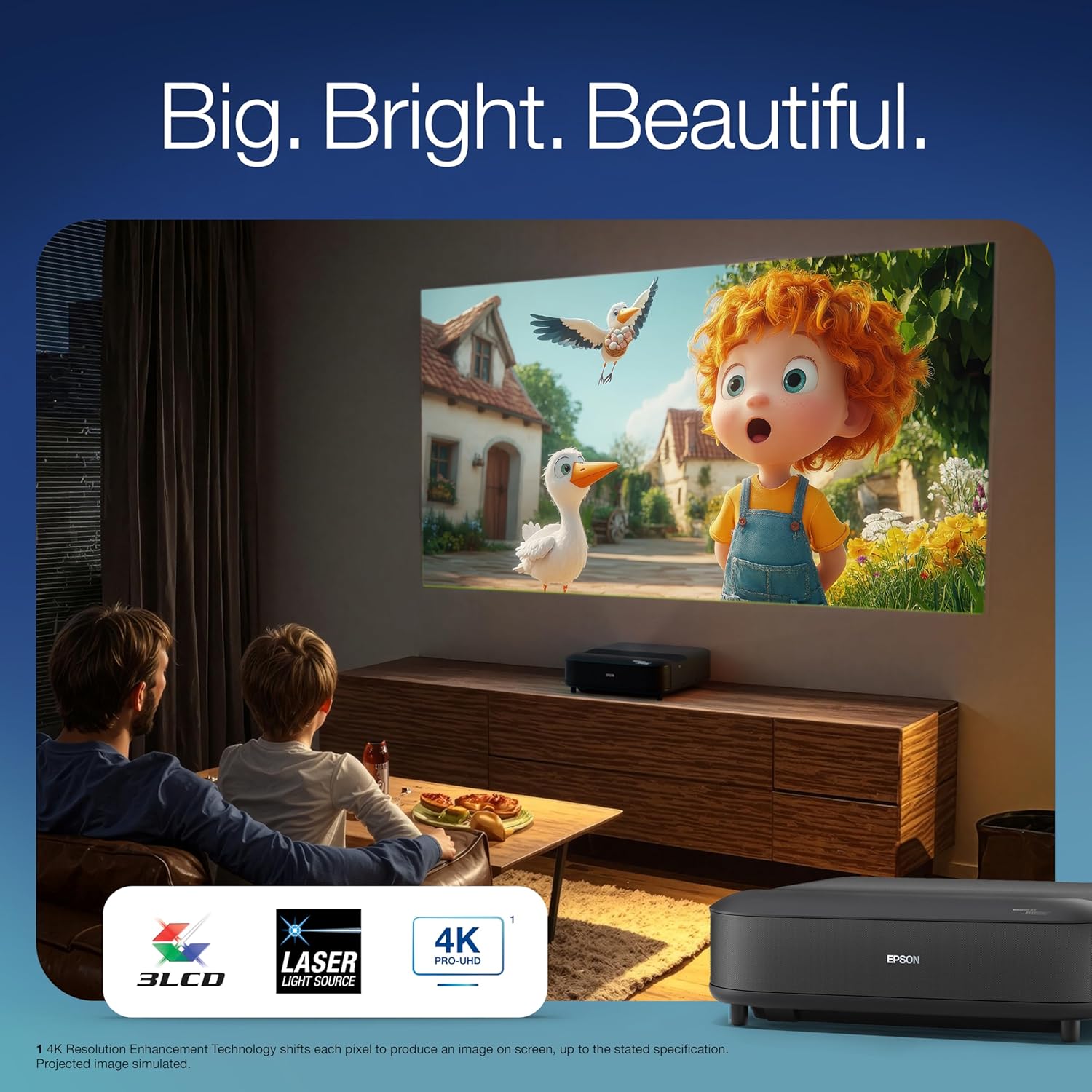
The LS800 is Epson’s flagship UST laser TV as of mid-2026, and it is the unit that Projector Central’s Epson LS800 review and spec analysis consistently recommends as the “safe” choice in this tier. It is a 4K laser projector rated at 4,000 ANSI lumens with a 3LCD light engine.
The 4K pixel-shift caveat: Epson uses a process called “4K Enhancement” rather than a native 4K imaging chip. A single 1080p chip shifts pixels rapidly across four positions to simulate 4K resolution. RTINGS.com’s UST projector and laser TV buying guide is candid about this approach: in side-by-side testing with a native 4K DLP projector, fine texture detail is marginally softer. In real viewing at 100–120 inches from a standard seating distance, the difference is not perceptible in typical content — movies, sports, streaming video — according to long-term owner impressions compiled in the AVS Forum UST laser TV owner thread. For 4K Blu-ray enthusiasts upgrading from a reference-quality display, it is worth knowing going in.
What the LS800 does well in aggregated owner reporting: exceptional out-of-box color accuracy, reliable auto-calibration via its built-in Android TV interface, and real-world brightness that holds up to its rated spec more consistently than competing DLP units at similar lumens ratings. The 3LCD engine does not produce the “rainbow effect” — a momentary color fringe that some viewers perceive with single-chip DLP projectors during fast motion or high-contrast transitions. For households with mixed viewers, including anyone who has reported sensitivity to DLP artifacts, this is a meaningful advantage.
Street price as of mid-2026: approximately $2,799 projector-only. Epson offers a bundle with their proprietary ALR screen that typically lands around $3,499.
Epson
$2,218.22
In stock on Amazon
Check price on AmazonAWOL Vision LTV-3500 Pro — The Color-First Choice
AWOL’s LTV lineup — anchored by the LTV-3000 Pro and LTV-3500 Pro — is built around a true triple-laser (RGB) light engine using a Texas Instruments DLP chip. Sound & Vision’s review of the LTV-3500 Pro gave it significant credit for color volume: the three-laser architecture produces a wider color gamut, approaching 107–110% of the DCI-P3 color space per AWOL’s published specifications, compared to single blue laser designs reviewed alongside it. The Home Theater HiFi ultra short throw projector comparison, 2025 edition, similarly identifies the RGB laser architecture as the standout differentiator for color-critical viewers at this price point.
The tradeoff is DLP-specific. Because AWOL uses a single DLP chip rather than three LCD panels, single-frame color artifacts are physically possible — though AWOL mitigates this with a high-frequency color wheel and software processing. Owner reports compiled in the AVS Forum UST laser TV owner thread and in the Home Theater HiFi ultra short throw projector comparison suggest the rainbow effect is a non-issue for the majority of viewers, but it remains a legitimate concern for a small subset of people who are predisposed to perceiving it.
AWOL bundles the LTV-3500 Pro with a Fresnel-based ALR screen that reviewers at Home Theater HiFi and Sound & Vision consistently praise for uniformity. The bundled package lands at approximately $3,499 — meaning the screen is included at roughly parity with what you would spend sourcing one separately. If color fidelity is your primary purchase driver and you watch a significant amount of HDR or cinema content, this is the strongest argument in the category at this price band.
One operational note that surfaces regularly in the AVS Forum UST laser TV owner thread: AWOL’s Android TV implementation is less polished than Epson’s. App availability and UI responsiveness trail behind in owner feedback as of early 2026. If you plan to use the projector’s built-in smart platform rather than an external streaming device, factor this in.
Epson
$2,699.99
In stock on Amazon
Check price on AmazonHisense PL2 — The Value and Reliability Leader
The Hisense PL2 — sold under the Laser TV branding in most markets — is the entry point into this three-way comparison at approximately $2,299–$2,499 for a bundled package that includes Hisense’s 100-inch ALR screen. It uses a blue-laser-plus-phosphor light engine rated at 3,000 ANSI lumens.
Digital Trends’ ranked review of the best laser projectors notes that the PL2 delivers genuinely impressive performance for its price point, with color accuracy that exceeds what the spec sheet alone would suggest. In ambient-light conditions — a living room in the afternoon with blinds partially open — the brightness gap between 3,000 lumens and 4,000 lumens becomes tangible in direct comparison. This is the most important real-world limitation for PL2 buyers to understand before committing.
The PL2’s included screen is the weakest of the three in aggregated owner feedback documented in the AVS Forum Hisense PL2 long-term impressions thread. It is functional, but owners who later replaced it with an Elite Screens Aeon CLR or a Silver Ticket STR-ALR panel reported a noticeable improvement in uniformity and off-axis rejection. If you select the PL2, treat the included screen as a baseline and budget $400–$600 for an upgrade within the first year.
Where the PL2 wins decisively: operational reliability at scale. Hisense has shipped more UST Laser TV units than any other manufacturer, and the long-term firmware update track record and service availability are strong. For hospitality operators, vacation rental owners, or HOA screening rooms that want a set-it-and-forget-it unit requiring minimal ongoing management, that ecosystem maturity is not a small thing. The PL2 is not the best performer in this group on any single benchmark. It is, however, the most operationally boring — and in a commercial or semi-commercial installation context, boring is precisely what you want.
XGIMI
$1,899.00
In stock on Amazon
Check price on AmazonBy the Numbers
| Feature | Epson LS800 | AWOL LTV-3500 Pro | Hisense PL2 |
|---|---|---|---|
| Rated lumens | 4,000 ANSI | 3,000 ANSI | 3,000 ANSI |
| Light engine | 3LCD + blue laser | RGB triple laser DLP | Blue laser + phosphor |
| Native 4K | Pixel-shift 4K | Native 4K DLP | Native 4K DLP |
| Street price (bundled w/ screen) | ~$3,499 | ~$3,499 | ~$2,399 |
| Built-in OS | Android TV (polished) | Android TV (rougher) | VIDAA (Hisense) |
| Rainbow effect risk | None (3LCD) | Low (DLP) | None (phosphor) |
| Best for | Bright rooms, mixed households | Color-critical, cinema use | Multi-unit, hospitality installs |
The Decision Rule
You have read the tradeoffs. Here is how to close the decision.
If your room gets meaningful ambient light during viewing hours and you have mixed household viewers — different ages, different sensitivities, no tolerance for display artifacts — buy the Epson LS800. The brightness advantage over the other two is real in everyday use. The 3LCD engine eliminates any rainbow artifact concern entirely. Epson’s smart TV implementation, as documented in Projector Central’s Epson LS800 review and confirmed by the AVS Forum UST laser TV owner thread, is the most polished of the three. The pixel-shift 4K limitation is a non-issue for the overwhelming majority of streaming and disc content at normal viewing distances. This is the safest choice and the one that Projector Central’s analysis defaults to for living-room buyers entering this tier for the first time.
If color accuracy is your primary concern and your room is reasonably controllable — meaning you can draw curtains or close blinds during a movie — buy the AWOL Vision LTV-3500 Pro. The RGB laser color volume advantage is real. Sound & Vision’s review of the LTV-3500 Pro and the Home Theater HiFi ultra short throw projector comparison, 2025 edition, both cite it as the standout characteristic of the platform. Plan to pair it with an external Roku or Apple TV streaming device rather than relying on the built-in Android TV platform for daily use.
If you are running a hospitality setup, vacation rental, or multi-unit installation on a per-unit budget constraint, buy the Hisense PL2 — and immediately allocate $400 toward a screen upgrade. The bundle savings relative to the Epson are real money across multiple installs. The PL2 carries the deepest service and firmware support infrastructure of the three, which matters when you are not present to troubleshoot. Digital Trends’ ranked review of the best laser projectors confirms the PL2’s value position relative to brighter and more color-accurate alternatives at higher price points.
One final point that applies to all three: every UST projector in this category requires an ALR screen to perform correctly. Projecting onto a painted wall or standard gain screen will not show what these units are capable of — the optics are engineered specifically for ALR material. Elite Screens’ Aeon CLR series and Silver Ticket’s STR-ALR are the two options most consistently recommended across Projector Central, AVS Forum, and Home Theater HiFi in this price band. The screen is not an accessory in a UST setup. It is half the system, and no projector reviewed here reaches its rated performance without one matched to it.