May 13, 2026 • Marlowe Finch • 9 min reading time • Specs verified June 4, 2026
Outdoor Movie Audio: Choosing a Bluetooth Speaker That Fills Your Yard Without Drowning the Dialogue
Picture this: you’ve got a crisp image on the screen, the popcorn’s out, and then the villain delivers the big monologue — and half the yard can’t make it out over the ambient noise. The projector gets all the attention when people plan a backyard movie setup, but audio is usually the first thing that lets the experience down. A Bluetooth speaker (a wireless speaker that connects to your phone, projector, or streaming device without any cables between them) sounds like a simple purchase, but choosing one for outdoor movie watching is meaningfully different from choosing one for a pool party playlist. Movie audio is dynamic — it swings between whispered dialogue and full action sequences — and your yard has none of the walls and ceiling that make indoor speakers sound fuller. This guide gives you a clear decision framework: match speaker output and placement to your yard size, dial in the feature set that actually matters for film, and avoid the common trap of buying a party speaker that makes music sound great but turns dialogue into mush.
Why Movie Audio Is a Different Problem Than Music Playback
This is the distinction most buyers miss, and it’s worth spending a minute on before we get to specs.
When you’re playing music outdoors, a speaker’s job is essentially to stay loud and energetic. The content is compressed — modern pop and streaming audio is mastered to be consistently loud throughout. Dialogue in a film is the opposite: it sits in a narrow frequency band (roughly 200Hz–4kHz, meaning the mid-range tones that carry the human voice), and it often plays at low-to-moderate volume right before a soundtrack or effects burst comes in at much higher volume. That swing is called dynamic range, and it’s the core challenge.
A speaker optimized for outdoor party use is typically voiced to emphasize bass (low thumping tones) and upper treble (bright, sparkly highs) because that combination sounds impressive and energetic with music. But that “V-shaped” tuning — named for the shape it makes on a frequency graph — tends to hollow out the mid-range, which is exactly where voices live. Reviewers at RTINGS.com flag this tuning pattern in several popular outdoor models and note it consistently correlates with listener complaints about clarity in speech-heavy content.
What you want for movies is a speaker with relatively flat or mid-forward frequency response — one that doesn’t sacrifice vocal clarity for boom. You also want enough headroom (the ability to get louder without distortion) to handle those sudden peaks without the speaker compressing or cracking.
The Yard-Size Framework: Matching Output to Space
Speaker output is measured in watts (W) — the electrical power the amplifier uses to drive the speaker. More watts generally means more potential volume, but the relationship between watts and perceived loudness is nonlinear and heavily influenced by speaker efficiency. Rather than chasing a watt number, it’s more useful to think in terms of coverage zones.
By the numbers:
| Yard depth (screen-to-back-row) | Recommended acoustic output | Speaker category |
|---|---|---|
| Up to 20 ft / ~25 guests | 20–40W (single unit) | Portable Bluetooth |
| 20–40 ft / 25–60 guests | 40–80W or stereo pair | Mid-size portable or powered outdoor |
| 40+ ft / 60+ guests | 80W+ or multi-zone system | Architectural or commercial |
A few important clarifications on that table. First, manufacturer watt ratings are often peak watts — the maximum the amplifier can momentarily produce — rather than RMS watts, which is the sustained, continuous output. RMS is the number that actually describes real-world loudness. Crutchfield’s outdoor speaker buying guide explicitly recommends comparing RMS specs when evaluating competing models because peak specs can be inflated by a factor of two or more. When a listing only shows one watt figure, assume it may be peak.
Second, outdoor space behaves very differently from indoor space acoustically. Sound outdoors has no surfaces to reflect off, so it doesn’t reinforce itself the way it does in a living room. A speaker that fills a 15-by-20-foot living room comfortably may struggle at the back of a 30-foot yard. The general field wisdom — echoed across aggregated owner reviews on models from JBL, Sonos, and UE — is to size up one category from what you think you need.
Features That Actually Matter for Film — and a Few That Don’t
What matters
TWS pairing (True Wireless Stereo): Many portable Bluetooth speakers let you pair two identical units, one playing the left audio channel and one playing the right. For movie watching, stereo separation — the way sound seems to come from different directions as things move on screen — is a genuine enhancement, not a gimmick. Wirecutter’s portable Bluetooth speaker reviews consistently call out TWS pairing as a meaningful upgrade for seated, focused listening versus casual background use. If your yard depth puts you in the 20–40-foot range, a stereo pair of mid-size units will serve you better than a single larger one.
Battery life with reserve: A feature film runs 90–150 minutes. Add 30 minutes of pre-show and post-credits, and you’re at 2–3 hours minimum. Look for a rated battery life of at least 4–6 hours at moderate volume, which gives you a real-world cushion. Owner reports across aggregated reviews suggest most portable speakers hit 70–80% of their rated battery life when pushed to outdoor movie volume levels — so a 6-hour-rated speaker gives you a comfortable buffer; an 8-hour-rated one gives you a double feature.
Bluetooth 5.0 or later with stable codec support: Bluetooth version determines connection range and stability. Bluetooth 5.0 (released in 2016, now standard on most post-2021 speakers) offers roughly double the range of Bluetooth 4.2 and meaningfully better stability when your source device — phone, streaming stick, or projector — is sitting at a distance. For movie audio specifically, you want no dropouts; a single audio glitch during a quiet scene is jarring in a way it isn’t during music. RTINGS.com’s testing methodology notes that codec support (the algorithm that compresses and transmits audio) matters mainly for music quality; for film dialogue, SBC (the default codec) is typically sufficient if the connection is stable.
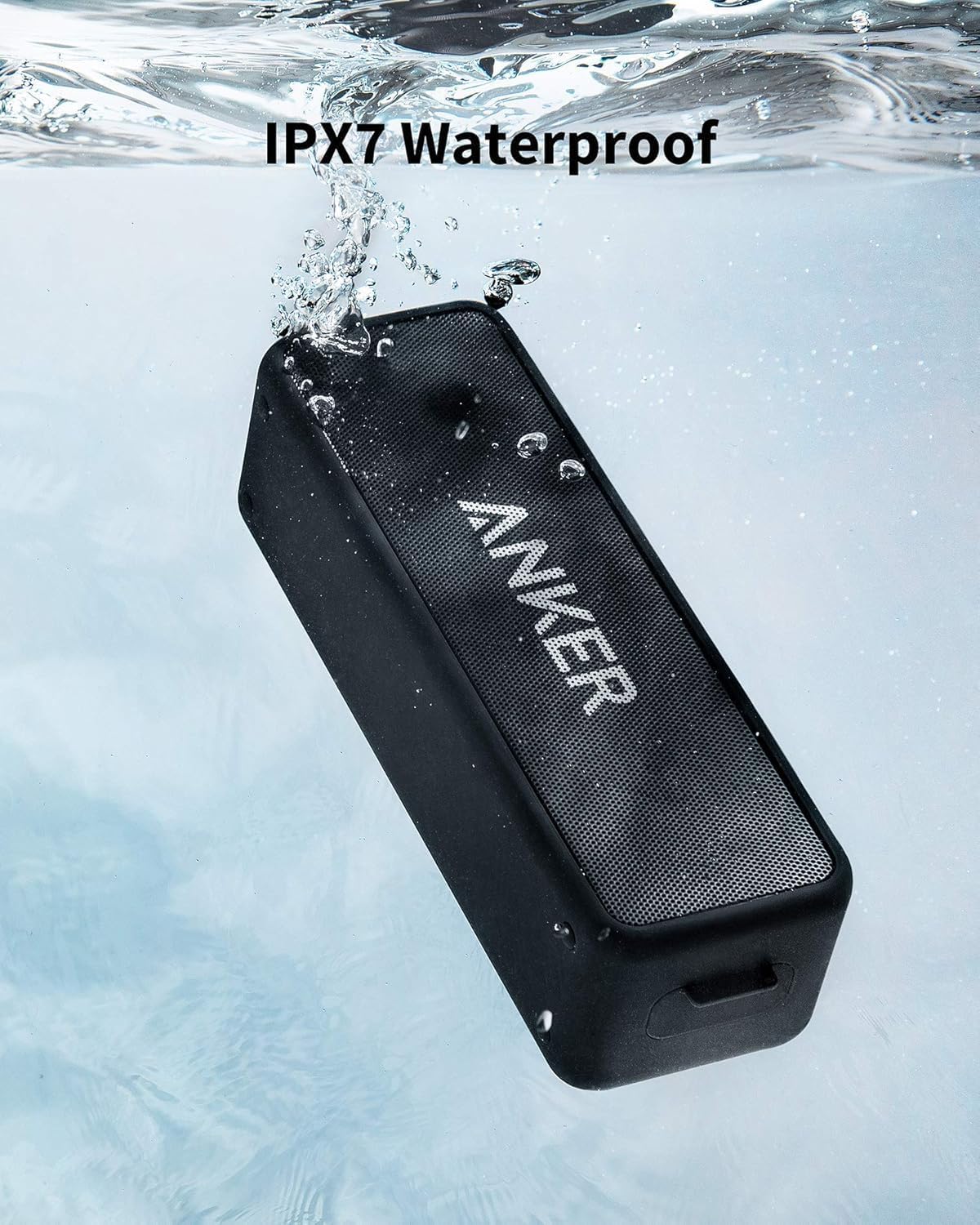
IP rating: Outdoor use means dew, unexpected drizzle, and inevitable spilled drinks. An IP67 rating (the “67” describes the level of dust and water protection — specifically, fully dust-tight and able to survive submersion in up to 1 meter of water for 30 minutes) is the current practical standard for serious outdoor use. IP65 (water jet resistant) is workable but leaves less margin. Skip anything rated only IPX4 (splash-resistant) for regular outdoor screening use — it’s built for the gym, not your lawn.
EQ controls or a companion app with EQ: Because movie audio demands mid-range clarity, a speaker with adjustable equalization lets you compensate for a bass-heavy default tuning. Not all portable speakers offer this, but models aimed at the enthusiast segment increasingly do. Sound & Vision’s coverage of the outdoor audio category notes that companion apps with parametric or at least multi-band EQ have become a meaningful differentiator in the $150–$400 segment.
What matters less for movies (but gets marketed heavily)
360-degree sound: Useful for a party where people stand all around a speaker; counterproductive for a movie where your audience is seated in a defined direction facing a screen. A 360-degree speaker disperses sound omnidirectionally, which means less energy projected toward your audience and more wasted on the fence behind the speaker.
LED light shows: Entertaining for about five minutes; then they’re a distraction during the actual film. Many speakers let you disable this, but verify before purchasing.
Maximum SPL claims: SPL stands for sound pressure level, measured in decibels, and it describes how loud a speaker can get. Manufacturers advertise peak SPL numbers that are measured in lab conditions at close range. Outdoor screening at 30 feet is not that condition. Treat SPL claims as relative comparisons within a brand’s lineup, not absolute promises.
Decision Rules: If X, Then Y
You’ve built the framework. Here’s how to translate it into a purchase call.
If your viewing area is under 20 feet deep and you’re hosting fewer than 25 people: A single quality portable speaker in the 20–40W RMS range — something like the JBL Charge 5 or UE Hyperboom — covers the space adequately. Prioritize flat frequency response and stable Bluetooth over raw wattage. Digital Trends’ outdoor speaker coverage regularly positions the JBL Charge lineup as the practical entry point for this use case based on aggregated owner satisfaction.
If your viewing area is 20–40 feet deep or you’re consistently hosting 25–60 people: Invest in a stereo TWS pair rather than a single larger unit. Two 30–40W speakers in stereo pairing will outperform a single 80W mono unit for dialogue clarity and stereo imaging. This is the sweet spot where a pair of JBL Xtreme 3s or a pair of Sony XG500s frequently surfaces in aggregated reviews as the right tradeoff of portability, output, and audio quality.
If your yard is 40+ feet deep, you’re running recurring events, or you’re operating in a commercial-adjacent context (vacation rental, HOA, boutique venue): Portable Bluetooth speakers are the wrong category. You need powered architectural outdoor speakers — wall- or post-mounted units wired to an outdoor-rated amplifier — or a system like Sonos’s outdoor speaker lineup designed for fixed installation and multi-zone control. The jump in setup complexity is real, but so is the jump in consistent performance. Crutchfield’s installation guides and B&H Photo’s commercial audio category both serve this buyer well.
If your projector already has a Bluetooth audio output: Confirm the Bluetooth version and whether it supports A2DP (the profile that handles stereo audio streaming). Some entry-level projectors expose Bluetooth only for input device pairing, not audio output — meaning your speaker needs to connect to the streaming source (Fire Stick, Apple TV, phone) rather than the projector itself. Check your projector’s manual before assuming the signal chain works the way you expect.
If your priority is dialogue clarity over everything else: Use the companion app to pull back bass and lower treble by 2–3dB, then boost the 1–3kHz range slightly. It will sound thinner when you test it standing next to the speaker. Sit at your actual viewing distance and it will sound like you turned the subtitles on.
Audio is the part of a backyard movie setup that people notice only when it’s wrong — muddy dialogue, a speaker that gives up at the back row, a connection that drops during the third act. Get it right and it disappears into the experience, which is exactly where it should be. Size to your space, prioritize mid-range clarity over boom, and pair to your actual signal chain. The screen and projector get the glory; the speaker does the work.